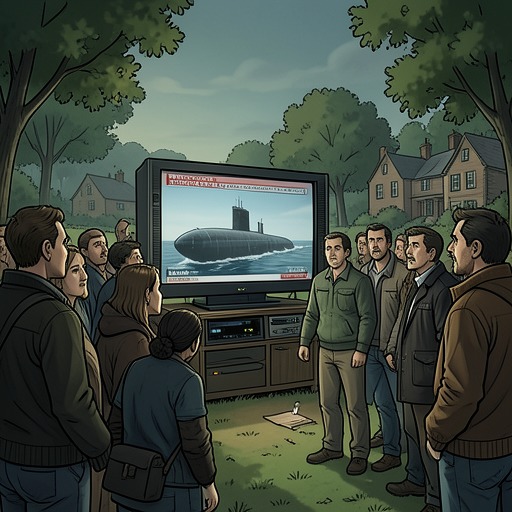
Soviet submarine grounding near Karlskrona
Let the Right One InThe Soviet submarine grounding near Karlskrona brings Cold War danger abruptly into the everyday life of Blackeberg. The submarine is first a distant military fact, its engine straining in the archipelago; by the following Wednesday, it has become schoolyard news and a prompt for children to imagine how a nuclear attack might reach even their homes. The episode also unsettles the suburb’s carefully ordered sense of itself: a place built without much connection to its past is shown to be far from insulated from history.
A planned suburb meets an unplanned threat
Blackeberg is described as a deliberately constructed residential district rather than a place that grew organically. Earth-colored concrete apartment buildings had been set among green fields, and residents arrived by subway, car, or moving van to furnish apartments whose shelves and storage spaces were already measured out for them. The town center, children’s playgrounds, green spaces, and pedestrian paths made it seem like a complete and orderly place to live.
Yet this finished environment had little historical depth. The children had no substantial local history project to undertake: an old mill, a tobacco king, and some buildings by the water belonged to a past with little connection to their present. Blackeberg had no church despite its nine thousand inhabitants. The narration links this modern, rational character to the residents’ freedom from the ghosts of history and terror, and then makes that apparent security part of the irony: they were, in part, unprepared. The submarine incident gives that vulnerability a concrete form. A threat originating beyond the suburb’s planned streets can suddenly reorganize what people there talk about and fear.
The grounding and its discovery
The submarine runs aground outside Karlskrona while attempting to free itself. Its engine roars and echoes across the archipelago, but no one goes out to investigate. The event does not first enter the story as a dramatic confrontation witnessed by the residents of Blackeberg; its arrival there is mediated by news, rumor, and speculation. It is discovered by accident on Wednesday morning.
The date heading identifies the day as Wednesday, 28 October. At school, a teacher has listened to the radio during recess and told a class about the news. By lunchtime, word has spread through the school: the Russians are there. The swift passage from radio report to playground certainty makes the incident feel both distant and immediate. The children are not presented with a detailed account of the submarine’s capabilities; what reaches them is the alarming fact of its presence, which their conversations then enlarge into possibilities.
From the murderer to the Bomb
For the children, the submarine news displaces a fear that had occupied them throughout the previous week: the Vällingby murderer. They had claimed to have seen him, and some said they had been attacked. Suspicion had attached itself to any character who looked sketchy. When an older man in ragged clothes crossed the school grounds, children ran screaming for cover, while some of the tougher boys prepared to knock him down with hockey sticks. They relented only after identifying him as a local alcoholic from the main square.
The change in subject is revealing. The children move from imagining danger in a nearby stranger to imagining danger arriving from a foreign power. They know little about the Russians beyond fragments of popular knowledge: hockey, the Soviet Union, spaceflight, and the Americans’ neutron bomb. Oskar talks the news over with Johan during lunch. He asks whether the Russians have the Bomb too and wonders whether it could be aboard the submarine. Johan says that it might; when Oskar questions how a submarine could deliver one without an airplane, Johan explains that rockets could be fired from wherever they were. Oskar looks up at the sky and asks whether submarines can carry them. The exchange does not establish that this particular submarine has nuclear weapons. It records the children’s attempt to make a frightening, poorly understood event imaginable using what they have heard about weapons and rockets.
Oskar’s final thought turns that speculation toward the familiar landscape: people might die while the houses remain standing. The image is starkly domestic. The buildings that had seemed to make Blackeberg a secure, finished home are imagined as surviving the destruction of the people who live in them. The children’s nuclear talk is not separate from their daily surroundings; it measures the vulnerability of those surroundings against a disaster they cannot see.
Anxiety enters adult conversation
The submarine continues to shape adult conversation beyond the school. In a discussion prompted by the possibility of a full-scale invasion, Larry asks where the nearest nuclear shelter is. Morgan answers that Larry could use the one in his building. He recalls going down there a few years earlier, when a defense official was taking inventory, and lists gas masks, canned food, and even a ping-pong table among its contents. His joking suggestion that Larry might be planning to hibernate gives the practical question a casual, social surface, but the shelter’s equipment confirms that the possibility of emergency has been anticipated materially as well as imagined.
That discussion unfolds amid ordinary hardship rather than apart from it. Morgan has just offered Lacke fried shrimp; Lacke has been drinking more and has no money left for food since Jocke disappeared. Morgan doubts there is reason for despair over Jocke, who has been missing for four days, and imagines he may simply turn up. Beside this unresolved personal worry, the submarine raises the scale of possible danger from one missing friend to invasion and mass destruction. The episode’s force lies in that coexistence: people still share food, joke, and speculate about an absent friend, while the news makes the survival of the whole country feel newly uncertain.
The grounding therefore changes more than the subject of conversation. The murderer’s imagined presence had made ordinary-looking people seem threatening; the submarine makes an international crisis seem capable of reaching ordinary homes. The story’s movement from radio news to school rumor, from Oskar’s upward glance to Larry’s question about a shelter, shows how a distant military event becomes part of local life without ever being directly witnessed by the Blackeberg residents. In a suburb that seemed to have escaped history, the news offers a sudden reminder that the outside world can arrive without invitation.